Kim Jiyoung
Kim Ji-young, Born 1982Kim Jiyoung’s life is shaped by a widening gap between the choices she hopes to make and the roles that family, employers, and social convention expect her to accept. Born in Seoul in 1982, she studies, joins the workforce, and builds a life with Jung Daehyun; after their daughter is born, she leaves her job to become the child’s primary caregiver. Her later dissociative episodes bring her to psychiatric treatment, but the clinical account of her distress ultimately opens onto the social world that has formed it: a world in which women’s work and sacrifice are often treated as natural, while their ambitions and exhaustion remain easy to overlook.
Identity and Background
Kim Jiyoung was born on April 1, 1982, in Seoul. Her father was a civil servant and her mother, Oh Misook, was a housewife. She grew up in a small, two-bedroom home with her parents, grandmother Koh Boonsoon, elder sister Kim Eunyoung, and, five years after her own birth, a younger brother. Among her earliest remembered experiences is sneaking spoonfuls of her brother’s formula. Her grandmother punished her for taking it, while Kim Eunyoung avoided it after being admonished once. The small incident captures a domestic order in which a resource associated with the boy was guarded from the girls, even within the intimacy of family life.
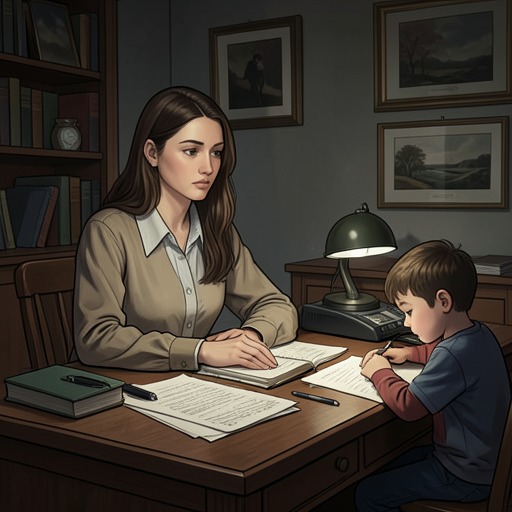
As an adult, Kim Jiyoung marries Jung Daehyun, an employee at a mid-size IT company, and they rent an apartment on the outskirts of Seoul. In 2015 she is thirty-three by international age, has a one-year-old daughter, Jung Jiwon, and is no longer working at the small marketing agency where she had been employed. Jung Daehyun often returns from work around midnight and also works on weekends. His parents live in Busan, while Kim Jiyoung’s parents run a restaurant; neither household is positioned to take over daily childcare. Once Jung Jiwon begins attending a half-day daycare in their apartment complex, Kim Jiyoung remains the child’s main caregiver outside those hours.
Education and Working Life
Before applying for jobs, Kim Jiyoung is hopeful about finding work that interests her and accords with her values. At a local cultural center she joins a study group that grows to seven regular members. They share job information, prepare CVs and cover letters, take part in volunteer and corporate-monitoring activities, apply for internships, and enter competitions. She works with Yun Hyejin on several competitions, and they win prizes in local-government contests and challenges for college students.
Yun Hyejin, who has stronger formal qualifications, is more pessimistic about their prospects. She points out that the alumni appearing at job fairs are men, and Kim Jiyoung recognizes that she has attended many such events without seeing a female alumnus. The broader figures for 2005 underline the imbalance: women made up 29.6 percent of new employees at one hundred companies, a share reported as a substantial improvement. In a separate survey, 44 percent of recruiting managers at fifty large corporations said they would prefer a male candidate when qualifications were equivalent; none favored women.
The barriers are not limited to formal applications. According to Yun Hyejin, informal recommendations from business departments or professors sometimes go to male students only, through a process whose criteria are difficult to establish. She tells Kim Jiyoung about a top-performing woman who discovered that four male students had been selected for interviews at a company that had requested candidates from their department. When the graduate challenged the recommendation process, she was given explanations that invoked the company’s preference for men, men’s lost years in military service, and their expected place as future household heads. The department head dismissed her complaint by treating her intelligence and insistence as burdensome. She eventually obtained a job through open recruitment, but left after about six months: she saw no women above a certain pay grade, and no one around her could say how long maternity leave lasted. When her boss blamed women for not staying, she answered that the workplace made staying impossible.
Kim Jiyoung’s own career also develops inside unequal assumptions about who will remain at work. At the agency, she and Kang Hyesu have established good reputations, yet when a new planning team is formed, the team includes capable managers and the two male colleagues who started alongside them, but not the women. The company head regards the project as a long-term investment and assumes women are less likely to stay in an intense job once childcare is involved. Kim Jiyoung and Kang Hyesu have been given more demanding clients, not because they are less capable, but because management is protecting the men it expects to retain. The exclusion turns a hidden employment assumption into a practical career limit: competence alone cannot secure access to the work that might lead to advancement.
Marriage, Motherhood, and Leaving Work
When Jung Daehyun suggests having a child, the proposal sounds casual to him, but Kim Jiyoung sees the scale of what may change. She has little direct experience with pregnancy or newborn care and cannot tell how motherhood will affect her body or whether she can sustain both work and childcare. Their jobs routinely extend into evenings and weekends, and their parents cannot provide dependable help. She worries that daycare and babysitting will not solve the problem, and feels guilty at the thought of arranging care for a child who has not yet been born.
Kim Jiyoung asks what Jung Daehyun himself would give up. Her own potential losses include her health, youth, job, colleagues, social ties, career plans, and future. His imagined sacrifices are principally reduced time with friends, discomfort about working late or attending business dinners, and the effort of coming home to help with chores; he also describes his financial responsibility as head of the household. The exchange makes visible how the prospect of a child distributes risk unevenly, even when both partners participate in the decision.
As the due date approaches, the couple writes out three options on a large sheet of paper: an immediate return to work, a return after a year of maternity leave, or no return. They consider childcare arrangements and costs for each. Sending the child to Jung Daehyun’s parents in Busan is not feasible because they are elderly and his mother has recently had back surgery. A live-in nanny would be expensive and would share the household’s daily life as well as care for the child. The couple concludes that one parent must stay home. Jung Daehyun’s job is more stable and pays more, and the familiar expectation that husbands work while wives raise children settles the decision in Kim Jiyoung’s direction.
She leaves without crying at the office, while returning her belongings gradually, or at the farewell gathering. The next morning, however, she wakes and begins planning an ordinary workday—breakfast near the station, lunch at the Jeonju Diner, perhaps a film, and a stop at the bank—before remembering that she no longer has an office to go to. Then the tears come. The agency had been her first workplace and, despite its limitations, had given her colleagues, accomplishment, income, and a sense that she was managing her own life. Her departure is not presented as a lack of ability or commitment. It is the consequence of a care arrangement that assigns her the cost of the family’s practical constraints.
The economic pressure continues after Jung Jiwon’s birth. The couple had paid off the loan on their apartment deposit, but when the lease is renewed, the landlord raises the deposit by 60 million won and they must borrow again. On Jung Daehyun’s income alone, buying a family home and later meeting kindergarten and after-school costs appear difficult. Kim Jiyoung knows women who return to work through freelance assignments, tutoring, service work, or part-time jobs; reports indicate that more than half of women who leave employment cannot find new work for over five years, and those who do often enter smaller workplaces or lower-paid sectors. The need to earn again therefore does not mean a simple return to the career she left.
Distress and Psychiatric Treatment
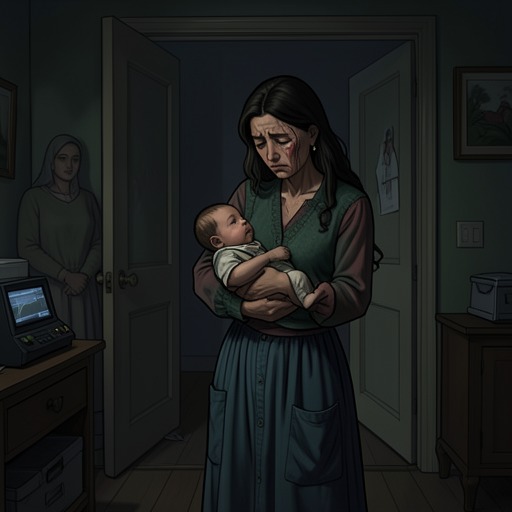
Jung Jiwon is born at four in the morning. Kim Jiyoung cries with happiness, but the daily care that follows is relentless: the baby cries when not held, feeding takes place every two hours, and Kim Jiyoung tries to keep up with housework and washing while sleeping in short stretches. Her wrists become inflamed, and a doctor explains that treatment options are limited while she is breastfeeding. The physical demands and disrupted routine accompany the transition into full-time care, rather than appearing as a separate burden.
In the autumn of 2015, Jung Daehyun first notices Kim Jiyoung behaving unusually when she opens a window on a bright, chilly morning and speaks in the manner of her mother, including a familiar wink and stretched-out cadence. At first he assumes she is joking or exhausted. A few days later, she speaks as Cha Seungyeon, a college friend who died after giving birth to her second child. Kim Jiyoung had been struggling with postpartum depression when she learned of Cha Seungyeon’s death, and the news had made ordinary tasks harder to manage. Later, while speaking as Cha Seungyeon, she urges Jung Daehyun to tell his wife that she is doing well and that her work raising a toddler is appreciated.
Another episode follows an encounter at a park. After taking Jung Jiwon to a nearby park and buying coffee, Kim Jiyoung hears office workers nearby disparage mothers who stay home. She hurries away, spills coffee on her hand, and returns home so shaken that she forgets meals and routine childcare tasks. When she tells Jung Daehyun that men at the park used a degrading label for mothers, he initially doubts that anyone would say it in person. She explains that she heard it herself and describes the price of the coffee, the pain of childbirth, and the life and work she feels she has surrendered to care for their child. The scene joins public contempt to private exhaustion: even a modest pause with a cup of coffee becomes a reason for strangers to judge her use of the family’s money.
Kim Jiyoung’s episodes are not treated by the narrative as a performance. At different times she becomes women she knows, living or dead, and does so with complete conviction. Jung Daehyun consults a psychiatrist and arranges an appointment, telling her that he is responding to her poor sleep and stress. She agrees that she has felt low and depleted and suspects maternity blues. In 2016, the psychiatrist reports that her symptoms have become less frequent but have not disappeared. He prescribes antidepressants and sleeping pills and sees her twice a week for forty-five-minute sessions.
Change and Narrative Significance
The psychiatrist initially interprets Kim Jiyoung’s condition as postnatal depression that has progressed into childcare depression, though he had considered dissociative disorder after hearing Jung Daehyun’s account. As treatment continues, her calm, articulate recollections of her life make him question whether he diagnosed her too quickly. She does not readily volunteer her suffering, but with encouragement she retrieves and describes old memories. The reconsideration does not erase her symptoms; it changes the clinician’s understanding of the world in which they occur. He recognizes that his medical training and experience have not given him an ordinary understanding of women’s lives, particularly the demands of childbirth and childcare.
The book thus places Kim Jiyoung’s distress beside a sequence of material conditions: gendered recruitment, exclusion from career-building work, unequal assumptions about future caregiving, the financial cost of raising a child, and the loss of professional identity after leaving employment. Her story does not resolve those conditions through a simple recovery or return to work. A later clinical reflection connects her predicament to another woman’s curtailed medical career and to a wife who finds control in working through elementary-school math workbooks, while wishing that both women could pursue work they value. Kim Jiyoung’s episodes make her private history impossible for the psychiatrist to dismiss as an isolated medical problem; they compel him to recognize the social structure he had previously failed to see.